Why an Entrance Can Change the Whole Room
A stage entrance can redirect attention before a performer speaks. Learn how timing, direction and the room’s layout shape that first encounter.
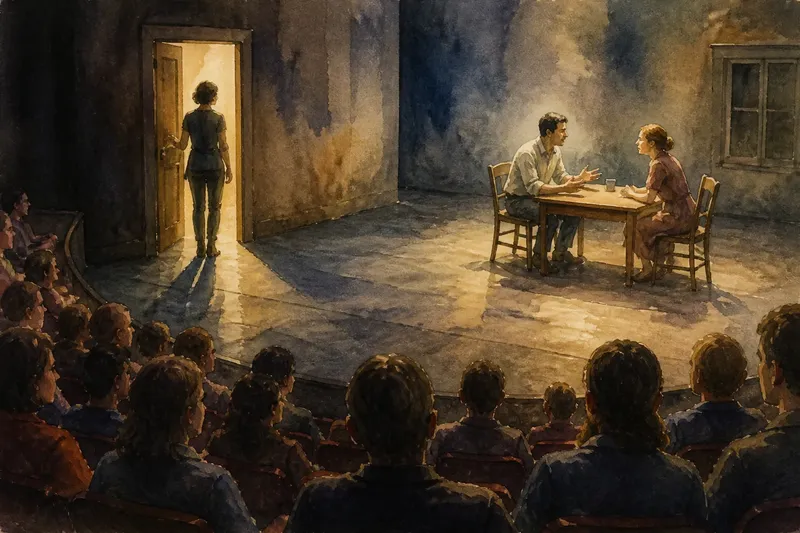
Why can a performer’s entrance make a familiar room feel suddenly different? A stage entrance can redirect attention before a word is spoken: a door opens behind the audience, a figure crosses an empty stage, or someone appears in a place that seemed unoccupied.
The effect comes from a relationship between movement and the room’s existing patterns. Audiences have already learnt where to look, what counts as a boundary and which routes seem possible. An entrance can confirm those expectations, disturb them or quietly make a new part of the space matter.
What does an entrance tell the audience before the performer speaks?
An entrance tells the audience where a character belongs, or suggests that they do not belong there. The route, pace and manner of arrival can imply familiarity, authority, hesitation or interruption without settling the meaning completely.
A performer who walks through a doorway and continues without looking around may seem at home in the room. Someone who pauses at the threshold and studies the space makes that boundary visible. The same doorway can therefore read as a routine passage or a significant divide, depending on how the performer meets it.
Arrival also gives the audience a first measure of the character’s relation to other people. A person who enters after a conversation has begun may seem to interrupt it; one who waits until attention has shifted elsewhere may appear to be avoiding notice. These impressions are provisional, but they prepare the audience to interpret what follows.
How does the direction of an entrance redirect attention?
Direction changes which parts of the room become active. A performer entering from a familiar side may draw the eye along a well-established route, while an arrival from behind or beside the audience asks spectators to turn towards a less-used area.
The shift need not be dramatic. A small movement near the edge of a playing space can pull attention away from a more brightly lit centre, especially if the performer’s stillness or pace contrasts with what is already happening. Where an audience is seated in a curve, the effect can travel from one section to another as people notice the movement and follow it.
For a performer, the route also shapes what the audience can see. Moving across the room may reveal a face gradually; approaching from behind may conceal it until the last moment. A direct path can make a character’s purpose feel plain, while a curved route leaves more room for uncertainty.
Direction is not simply a matter of choosing the most visible entrance. A route that is easy to see may also feel socially exposed; one partly screened by scenery or another performer can suggest secrecy. The useful question is what the route makes spectators attend to: the arriving body, the boundary being crossed, or the reactions of those already present.
When should a performer enter rather than wait?
A performer should enter when their arrival can change the audience’s understanding of the moment. Entering early lets spectators watch the character become part of the scene; entering late can make the arrival itself the event. The right timing depends on whether the scene needs anticipation, interruption or a gradual change in focus.
Waiting can be active rather than empty. A performer held just outside the visible space may make an existing doorway or edge seem charged, particularly if the audience has reason to expect someone. But if spectators have no reason to notice that boundary, the wait may not register at all. The performance needs some legible relation between the expected arrival and the space being watched.
Timing also affects the people already on stage. An entrance that coincides with a change in another performer’s attention can create a clear handover of focus. If several people move at once, the new arrival may be absorbed into the general activity rather than read as a distinct event.
Imagine a scene in which two performers are speaking beside a table, while a third waits beyond a side door. If the third enters during a pause and stays just inside the doorway, the audience can register the threshold and the others’ responses before the newcomer advances. If the performer instead crosses straight to the table during a line, the interruption may feel sharper, and the room’s focus shifts towards the collision of movement and speech.
How can an entrance establish a relationship to the room?
An entrance establishes whether a performer treats the space as familiar, contested or unfamiliar. The evidence lies in observable choices: whether they cross the centre, skirt the walls, test a boundary, or move directly towards another person.
A character who claims the centre can seem to command attention, but the centre has no fixed meaning in every production. In a narrow room, a doorway may carry more weight; in a theatre with spectators on several sides, a route that acknowledges one audience section may exclude another. The room’s shape and the audience’s sightlines help determine what the movement communicates.
The performer’s pace and orientation can refine the impression. Moving with an unbroken stride may suggest ease or resolve; stopping to orient towards the room can suggest caution or an attempt to take stock. Turning one’s back on part of the audience may be intentional, but it also changes who can see the face and who must infer the character’s response from posture.
Design can support this relationship without explaining it. A change in light may draw attention to a doorway, while a sound from outside the stage may suggest a space the audience cannot see. These elements work best when they leave the performer’s route readable rather than competing with it.
What rehearsal choices make an entrance read clearly?
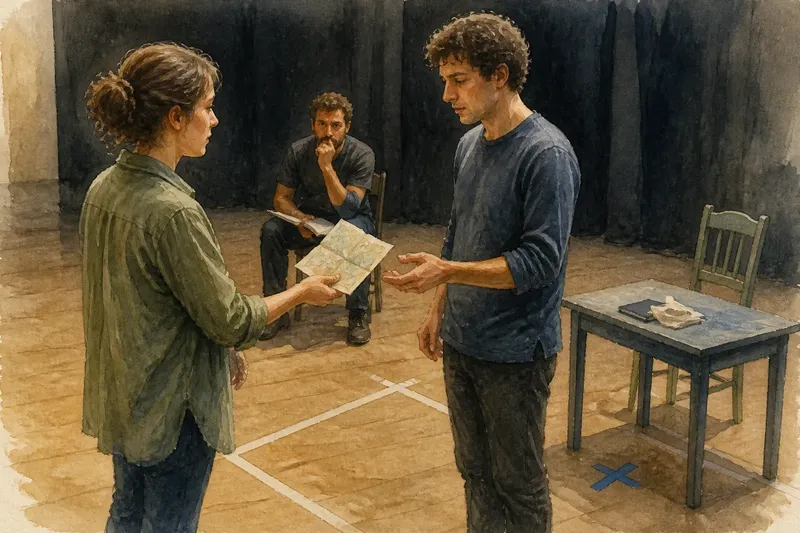
Rehearsal can clarify an entrance by making its point of attention specific. The performer and director can ask what spectators should notice first: the sound of arrival, the crossing of a boundary, a change in another character, or the newcomer’s destination. That decision helps prevent every part of the movement from asking for equal attention.
- Mark the threshold. Decide whether the performer pauses, crosses without stopping or changes pace at the boundary.
- Choose a route. Check whether the path brings the performer into view gradually or reveals them all at once.
- Set the timing. Place the entrance in relation to a line, pause or movement already happening on stage.
- Agree on the first focus. Decide whether spectators should watch the arrival or the reaction it causes.
- Check the audience’s view. Consider whether people at different sides of the room can follow the route and read the performer’s face.
These choices are not a formula for making every arrival conspicuous. A deliberately ordinary entrance can help a scene feel settled, while a hesitant arrival can make the room itself seem unfamiliar. Clarity means that the audience can read the intended event, not that every entrance must be large.
Why does an entrance sometimes feel unnoticed?
An entrance can go unnoticed when it competes with a stronger visual or audible event. A performer crossing behind a busy group, moving during a loud exchange or emerging in a poorly visible part of the room may not receive attention, even if the route is clear to the cast.
It may also be unnoticed because the movement has no consequence. If the arrival neither alters a relationship nor redirects the scene, spectators may register it without treating it as meaningful. That can be useful when the character is meant to blend into ordinary activity; otherwise, the timing or the response from those on stage may need to make the change legible.
There is a difference between visibility and emphasis. A spotlight can make a body easy to see, but it cannot by itself explain why the audience should care about the crossing. The entrance acquires meaning through its relation to what has already happened and what changes once the performer is present.
Can the same entrance work in every room?
No single route has the same effect in every venue. A side entrance may be intimate in a small studio and distant in a large auditorium; a performer approaching through the audience may feel close to some spectators and remote to others.
Before settling the movement, consider where the audience sits, which routes they can see, how sound travels and whether the performers need to share the space with spectators. A doorway may also have practical limits, so the exact route should suit the venue and the production’s arrangements.
For a live performance, the entrance is not merely the point where a character appears. It is a chance to show how that character meets the room: by claiming it, resisting it, slipping through it or waiting for it to make space. When you assess a stage entrance, watch not only the performer’s arrival but also where attention goes next.