Handheld Prop or Fixed Set Piece?
Handheld prop or fixed set piece? Compare handling, transfer and repeated use to choose an object form that makes a scene’s action clear and repeatable.

Handheld prop or fixed set piece: which form lets the audience understand what changes in the scene? A folded letter that passes between two actors can make a choice visible; a permanently placed counter can give their exchanges a stable setting. The right form depends on the object’s work, not on which version looks more realistic.
Start by tracing what the object does from its first appearance to its last. Does someone need to carry, offer, hide or refuse it, or does its steady position shape the action? Those demands point towards a portable prop, a fixed element, or a combination with distinct jobs.
Trace each appearance before choosing a form
Mark every moment in the script when the object is seen, touched, moved, named or ignored. Beside each cue, record who controls it and what changes when it is present. This simple record distinguishes an object that advances the action from one that establishes the scene’s spatial structure.
A ledger passed between characters may gather meaning through transfer. A window frame that keeps one character apart from the others may do its work without anyone touching it. Include absences, too: a prop that disappears before a later scene can matter as much as one that remains in view.
Then describe the audience’s essential observation in plain language: “Mara chooses to return the key” or “the counter keeps the characters apart”. If the sentence depends on a handoff, movement matters. If it depends on a stable boundary or location, a fixed element may serve the scene better.
Compare the action each form can support
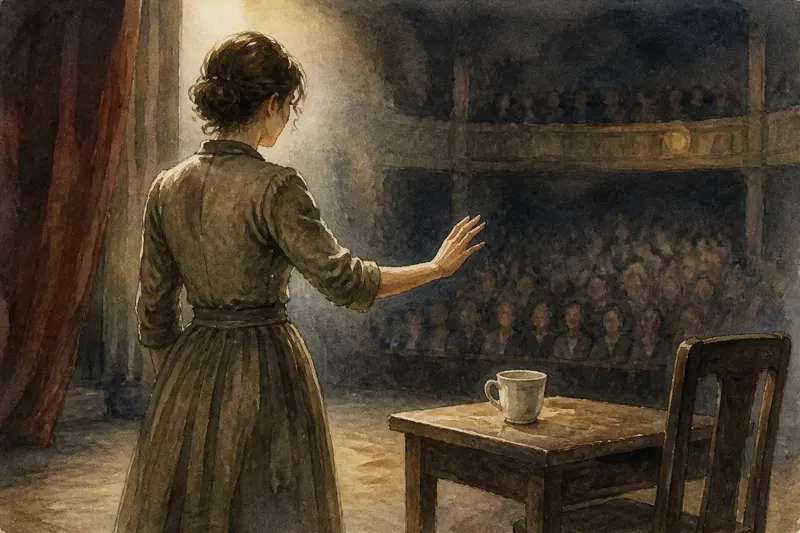
A handheld prop supports contact and change. An actor can pass it, conceal it, set it down or refuse to take it, making a decision part of the physical exchange. That flexibility also asks the performer to manage its position and handling consistently, so each gesture should have a reason in the scene.
A fixed set piece supports continuity. A built bench, counter or doorway can establish a repeated meeting place or divide the playing area without needing to be carried or reset as a hand prop. Its meaning develops through how performers approach, avoid or occupy it.
Neither form is automatically clearer. A portable object may distract if an actor handles it without adding information; a fixed element may be unnecessary if the scene relies on a revealing transfer. Choose according to the action the object must make possible, rather than treating portability as a general advantage.
Use a focused rehearsal week to compare the forms
Give each day a specific task and keep the same short scene for comparison. Use a borrowed, safe rehearsal object and a taped floor mark or lightweight marker in place of a built set piece. These stand-ins are for exploring the action, not deciding the final material or construction.
- Day one: Mark the object’s cues in the script and write down the action each cue must make clear. If the action depends on transfer or handling, keep the portable version in consideration; if it depends on a stable location, include a fixed version.
- Day two: Play the scene without an object. If the essential action remains clear, consider removing the object; if a decision or relationship becomes harder to follow, retain an object that can carry that information.
- Day three: Use a rehearsal stand-in as a handheld prop and play the scene with the planned transfers or gestures. If those actions clarify the exchange without interrupting it, keep the portable option; if handling adds no useful change, test a fixed form instead.
- Day four: Mark the fixed location with tape or a lightweight marker and replay the same scene. If the stable position supports the action, develop the fixed option; if the scene needs the object to travel, return to the portable version.
- Day five: Try the form that seemed clearer in the previous runs, including its entrances, placement and handoffs. If performers can repeat the action consistently, retain it for further design work; if cues remain uncertain, simplify the handling or location and replay the scene.
- Day six: If the scene needs both a stable setting and a changing object, try them together, such as a fixed table and a portable letter. If each has a separate job, keep both; if they compete for the same attention, remove or simplify one.
- Day seven: Review the notes and choose the form that best supports the essential action and can be repeated by the performers. If neither option does both, identify the unresolved constraint and seek an alternative before committing to a finished design.
For any final object or structure, check relevant handling, construction and venue requirements with the appropriate production professional. A rehearsal stand-in can clarify dramatic function, but it cannot establish whether a final design is suitable for every production context.
Decide whether the object needs to travel
When does a handheld prop help the action?
It helps when contact or transfer changes what the characters are doing: passing a note, hiding a key or declining a glass can make a choice visible. If the scene would play the same without the handling, the prop may not need to be portable.
When does a fixed set piece suit the scene?
A fixed piece suits an object whose position matters more than its movement. A counter can anchor recurring exchanges, while a doorway can maintain a boundary between characters across several moments.
Can a scene use both a prop and a fixed piece?
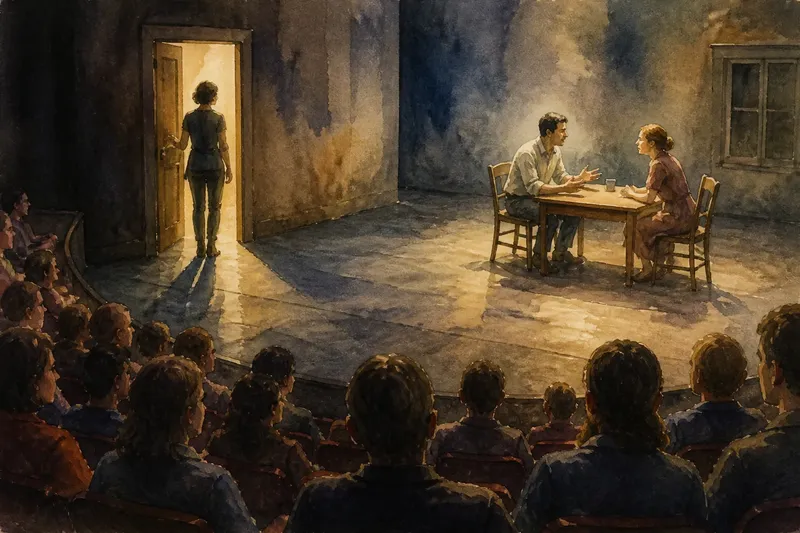
Yes, when their functions differ. A fixed table might establish the room while a portable letter carries new information; if both merely mark the same location or idea, simplify the arrangement.
How can a team compare forms before building scenery?
Use a rehearsal object for the portable version and tape or a lightweight marker for the fixed position. Play the same exchange with each, then note which actions performers can repeat clearly and which version supports the scene’s essential change.
Make repetition part of the design decision
For a portable prop, establish who handles it, where it begins and where it rests after each cue. A fixed element avoids hand-to-hand transfer, but still needs a consistent place in the staging and a clear purpose across the scenes that use it.
Imagine a touring production working with a folded map. In rehearsal, the starting inputs are a scene in which an actor retrieves the map before changing their plan, a borrowed paper stand-in and a fixed floor mark for a possible map location. The team first plays the scene with no map, then has the actor retrieve and open the stand-in, and finally tries leaving it at the marked location.
In this invented situation, the no-map version obscures why the actor changes course, while retrieval and opening make the decision part of the action. Leaving the map fixed removes that change in handling, so the team keeps a portable map for further design work and records its starting place and retrieval cue. The expected observable result is that performers can repeat the retrieval at the same point and the map’s role in the decision remains clear; if the action still varies, the team can simplify the cue before selecting a final prop.
Give combined objects separate jobs
A fixed table and a portable letter can coexist because one anchors the room while the other changes hands. State each function in the design notes and remove an element if it duplicates the other’s work. This keeps the choice focused on the scene’s recurring need: transfer and handling favour a handheld prop; stable position and repeated use favour a fixed set piece.
For a practical decision about a handheld prop or fixed set piece, keep the cue record with the script and note who handles the object, where it begins and what action it supports. That record makes the intended use easier to preserve when staging changes, without asking the object to carry more meaning than the scene requires.